
Home EV Charger Installation Cost: What to Budget in 2026
Home EV Charger Installation Cost: What to Budget in 2026
Most homeowners pay between $900 and $2,500 for a complete Level 2 charger installation, with an average near $1,700 when the electrical panel is already in decent shape. The two things that blow past that range fast: a panel upgrade and a long, hard-to-reach wire run. If your panel needs replacing, that same job can climb to a considerably higher cost. Before you call an electrician, check DSIRE and your utility’s rebate page. Both can shrink your final bill more than any negotiating you do with the installer.
Key Takeaways
A home Level 2 EV charger installation typically costs $900 to $2,500 with a panel-ready home, and panel upgrades or long wire runs are what push that number toward $3,000 to $6,000.
| Point | Details |
|---|---|
| Typical cost range | Budget $900 to $2,500 for a standard install; expect $3,000 to $6,000 if your panel needs upgrading. |
| Biggest cost swings | Panel capacity and wire-run distance drive most of the difference between low and high quotes. |
| Check incentives early | Verify the federal 30C credit and utility rebates through DSIRE before assuming eligibility. |
| Compare itemized quotes | Require permit, breaker, conduit, and labor as separate line items before comparing bids. |
| Find installers locally | Use Local AI Page’s ZIP-code search to shortlist verified local electricians and compare service areas quickly. |
Authoritative Resources to Verify Costs and Incentives
- DSIRE for state and utility rebate listings.
- DOE/AFDC for federal eligibility guidance.
- Your utility’s own EV program page, since rebates and funding change often.
Table of Contents
- What Determines Your EV Charger Installation Cost
- How Much Does a Typical Installation Cost by Scenario?
- Which Charger and Amp Rating Do You Actually Need?
- How Do You Find and Apply EV Charger Incentives?
- How Long Does an EV Charger Installation Take?
- How Do You Prepare for Electrician Quotes?
- How Do You Vet a Local EV Charger Installer?
- What Homeowners Get Wrong About Budgeting
- Find a Local EV Charger Installer by ZIP Code
- Frequently Asked Questions
- Sources
What Determines Your EV Charger Installation Cost
Every quote you get boils down to the same handful of variables, and knowing them lets you guess your own price range before an electrician ever sets foot in your garage.
- Panel capacity — an older 100-amp panel with little room left may need a sub-panel or full service upgrade, while a modern 200-amp panel with open breaker slots keeps costs low.
- Wire-run distance and path — running conduit through an open basement is cheap; fishing wire through finished drywall or across a detached garage is not.
- Charger amperage and connection type — a 40A hardwired unit needs different wire gauge and breaker sizing than a 48A unit on a plug-in outlet.
- Mounting location — an attached garage near the panel is the easy case; a detached garage often means trenching.
- Permitting and inspection — required in nearly every jurisdiction, and fees vary by city; see Solar Panel Disposal Laws: What U.S. Businesses Must Know for insight into permitting and electrical compliance that can intersect with large electrical projects.
- Local labor rates — electrician hourly rates swing widely by region and season.
Wire and conduit typically run $5 to $12 per foot installed, so a 10-foot run and a 50-foot run aren’t remotely the same job. Panel upgrades follow rough bands: a sub-panel addition often lands in the low thousands, while a full service upgrade (swapping the main panel or upsizing utility service) pushes total project costs toward the $3,000 to $6,000 range electricians and cost guides both cite.
Pro Tip: Ask every electrician to itemize the permit fee, breaker cost, conduit length, and any trip or travel charge separately. A quote that just says “installation: $1,800” is hiding information you need to compare bids fairly.
How Much Does a Typical Installation Cost by Scenario?
Installers generally group jobs into four tiers, and where you land depends almost entirely on your panel and wire run.
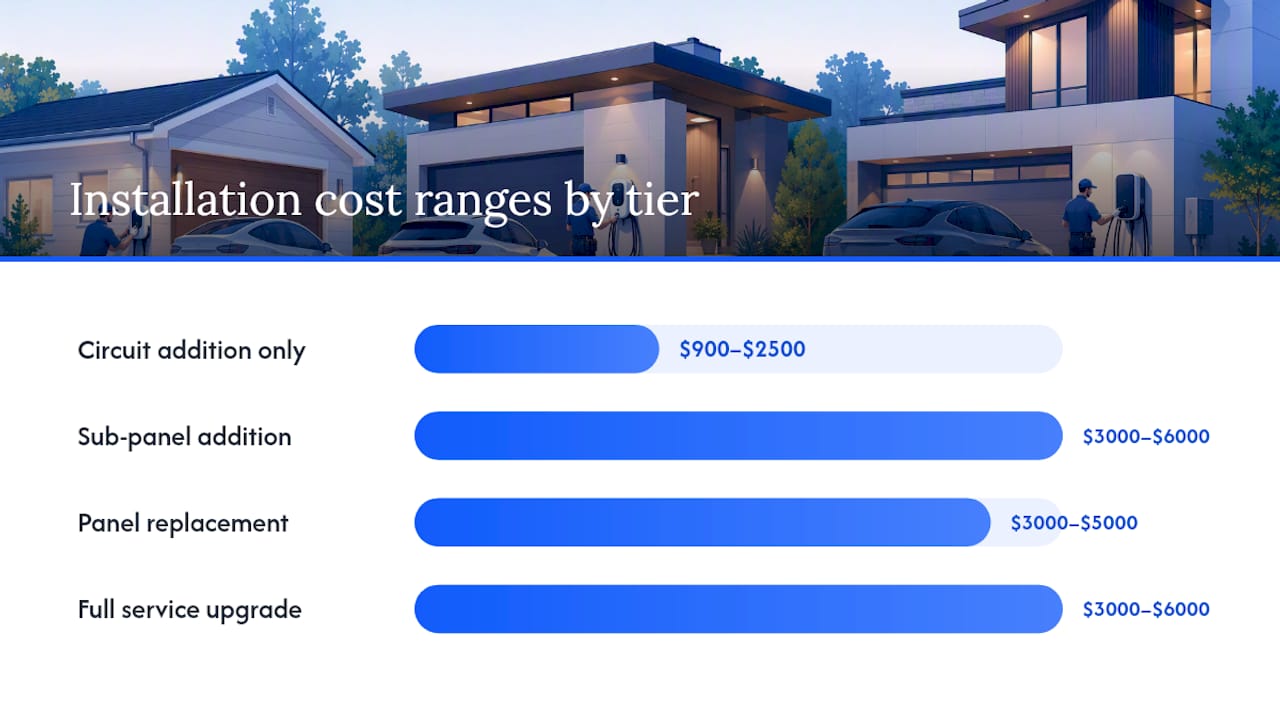
| Tier | Typical Range | What’s Included |
|---|---|---|
| Circuit addition only | $900–$2,500 | New breaker, short wire run, charger mount, permit |
| Sub-panel addition | $3,000–$6,000 | New sub-panel, wiring, breaker, permit and inspection |
| Panel replacement | $3,000–$5,000 | Full panel swap, rewiring, permit, inspection |
| Full service upgrade | $3,000–$6,000 | Utility coordination, new service line, panel, wiring |
A simple example: a panel-ready home with a 15-foot run typically totals close to the $1,698 baseline modeled by cost calculators, breaking down roughly as $500 for the charger, $700 for labor and materials, $150 for permit and inspection, and the rest in miscellaneous hardware. A moderate job with a longer run or minor panel work lands closer to $2,200 to $2,800. A complex job, detached garage, trenching, and a panel upgrade, can reach $5,000 or more before any incentive is applied.
Which Charger and Amp Rating Do You Actually Need?
Level 1 charging (a standard 120V outlet) adds roughly 3 to 5 miles of range per hour, fine for plug-in hybrids or light daily driving. Level 2, at 240V, is what most homeowners actually need and want, since it turns an overnight charge into a full battery.
- 32A chargers suit lighter daily driving and smaller circuits.
- 40A chargers are the most common choice, adding about 30 miles of range per hour.
- 48A chargers push closer to 37 miles per hour but require a 60A continuous-rated circuit, which raises wiring and breaker costs.
- Plug-in NEMA 14-50 outlets are cheaper to install and let you unplug the charger; hardwired units cost a bit more upfront but tend to be more durable outdoors.
Hardware itself, separate from labor, typically runs $300 to $700. Units from ChargePoint, Wallbox, JuiceBox, and Emporia generally sit in that band, while Grizzl-E often comes in at the lower end and the Tesla Wall Connector tends to price mid-range. Higher-end smart chargers add app connectivity and, in some cases, a subscription fee, and most reputable brands back their hardware with a 3-year warranty.
How Do You Find and Apply EV Charger Incentives?
The federal 30C credit has covered up to 30% of installation costs, capped near $1,000, but eligibility depends on census-tract rules. The credit is set to expire June 30, 2026, so confirm current status before counting on it. State and utility rebates fill the gap in many areas, though they shift constantly as funding runs out.
- Check DSIRE for state and utility program listings.
- Use the DOE/AFDC eligibility map and current IRS guidance to confirm the 30C credit applies to your address.
- Visit your utility’s own EV program page directly, since rebates change faster than most guides can track.
- Confirm your census tract meets the current 30C eligibility rules before you factor the credit into your budget.
Pro Tip: Save every line item on your final invoice and get written confirmation from your installer that the work meets your program’s requirements. Rebate administrators often reject claims over missing paperwork, not missing work.
How Long Does an EV Charger Installation Take?
A standard install typically runs one to three weeks from your first call to final inspection. The actual electrical work is often just a few hours for a straightforward circuit addition.
- Initial call and load check, then a site visit and written quote.
- Permit pull, which can take days depending on your municipality.
- Installation day, typically 3 to 6 hours for a simple job or 1 to 2 days when a panel upgrade is involved.
- Final inspection and sign-off before you plug in.
Pro Tip: Book your electrician as soon as you order your charger. Busy metro electricians can be scheduled out weeks, and panel upgrades add utility coordination time you can’t rush.
How Do You Prepare for Electrician Quotes?
Show up to your first conversation with a few basics ready: a photo of your panel and its amperage label, the distance from panel to charger location, whether you already have a sub-panel, and whether your garage is attached or detached. That alone lets an electrician give you a far tighter estimate over the phone.
When quotes come in, make sure each one answers the same questions:
- Does the price include the permit and inspection fee?
- Is the breaker, wire, and conduit itemized separately?
- Are there travel or trip charges?
- Is the install hardwired or a NEMA 14-50 outlet, and does that change the price?
- What warranty or post-install support is included?
If two bids differ by more than a few hundred dollars, ask both electricians to explain their wire-run assumptions. That’s usually where the gap comes from.
How Do You Vet a Local EV Charger Installer?
Confirm the electrician is licensed and insured, then ask for a permit reference number or photo from a past EV installation. A contractor who has done this work before should have no trouble producing one.
- Ask whether they perform a load calculation before quoting, not just a walk-through.
- Request a sample of a prior EV charger permit or inspection sign-off.
- Read recent reviews and look for photos of finished panel and mounting work.
- Use a ZIP-code search like Local AI Page to shortlist installers with listed service areas, so you’re comparing local electricians, not chasing companies that won’t cover your address.
What Homeowners Get Wrong About Budgeting
The most common misstep is calling for quotes before measuring anything. Homeowners who show up with only “I want an EV charger” get vague, padded estimates. Measure your panel’s open breaker slots and the distance from panel to parking spot first. That single step, borrowed from what installers do on a load calculation, narrows your quote range dramatically and makes bids easier to compare side by side. Use the checklist above every time you request an estimate.
Find a Local EV Charger Installer by ZIP Code
Comparing electricians shouldn’t mean calling five companies and hoping one calls back. Local AI Page gets you there faster: search by ZIP code and see verified local electricians with service areas, contact details, and reviews side by side, so you can request quotes from installers who actually cover your address instead of guessing.

- Search by ZIP code to find electricians serving your exact area.
- Browse verified business profiles with service details and reviews.
- Get direct contact information without filling out a lead form.
- Compare multiple local installers before committing to a quote.
If you’re ready to start gathering bids, search local electricians by ZIP code or check listings for areas like Lombard, IL to see how detailed a business profile looks before you reach out.
Frequently Asked Questions
How much does EV charger installation cost on average? Most homeowners pay around $1,700 for a standard Level 2 install, with a typical range of $900 to $2,500 depending on panel condition and wire-run length.
Do I need a 240V outlet or hardwired connection for a Level 2 charger? Yes, Level 2 charging requires 240V. You can choose a NEMA 14-50 plug-in outlet or a hardwired connection; hardwiring costs slightly more but suits outdoor or heavy daily use better.
Will a panel upgrade always be necessary? No. Many homes with an open breaker slot on a 200-amp panel only need a circuit addition. A load calculation before your quote tells you which scenario applies to you.
How long does the whole process take from quote to working charger? Expect one to three weeks from your first call to final inspection for a standard job, longer if a panel upgrade requires utility coordination.
Are EV charger tax credits and rebates still available? Some are, but eligibility rules and expiration dates change. Check DSIRE and the DOE/AFDC eligibility map before assuming a credit applies to your address.