
How to Get Local Leads: Practical Strategies for Small Businesses
How to Get Local Leads: Practical Strategies for Small Businesses

The three fastest ways to get local leads right now are Local Services Ads (pay-per-lead, verified badge, top of search), an optimized Google Business Profile, and geo-targeted paid ads with a sub-five-minute follow-up response. Start with all three in parallel, even at a small budget, and you will see inbound contacts within days rather than weeks.
First actions to take this afternoon:
- Claim or verify your Google Business Profile at business.google.com and fill every field (hours, photos, services, description)
- Enable call and text routing so inbound leads reach you on your phone immediately
- Set a $10–$20 daily geo-targeted search ad test on your top two or three service keywords with a ZIP code radius
Your next 60 minutes: Claim your GBP, add five photos, and turn on messaging. That single move costs nothing and can produce calls by tomorrow.
Pro Tip: Most businesses lose leads not because they never appear in search, but because they respond too slowly. Research from Google consistently shows that response speed is one of the strongest conversion levers for local service businesses. Aim to reply within five minutes of any inbound contact.
Key Takeaways
The fastest path to consistent local leads combines a free, optimized Google Business Profile with a small paid test on Local Services Ads, tracked weekly against cost-per-lead and response time.
| Point | Details |
|---|---|
| Start with free channels first | Claim and fully optimize your GBP and directory listings before spending on ads. |
| LSA beats standard PPC for intent | Pay-per-lead Local Services Ads tie spend directly to inbound contacts, not just clicks. |
| Respond within five minutes | Speed of response is one of the strongest conversion levers for local service leads. |
| Track cost-per-lead weekly | Log leads by channel in a spreadsheet; after 30 days, double down on the lowest-CPL source. |
| Local AI Page accelerates discovery | A complete ZIP-code profile on Local AI Page puts your contact details in front of nearby searchers without ad spend. |
Table of Contents
- What is local lead generation and how does it work?
- Why local leads convert faster than national ones
- Proven strategies to get local leads across every channel
- How to build a repeatable local lead-generation system in 30 days
- What does local lead generation actually cost?
- Common mistakes that waste your local lead budget
- How to use a local business discovery platform to accelerate lead capture
- How does voice search affect local lead generation?
- Legal and privacy considerations for local lead generation
- The channel most small businesses get wrong
- Local AI Page helps you get found by ZIP code
- Frequently asked questions
- Sources
What is local lead generation and how does it work?
Local lead generation is the process of attracting potential customers within a specific geographic area and converting their interest into a direct contact: a phone call, a booking request, a contact-form submission, or a walk-in.
A few concrete examples of what a local lead looks like in practice:
- A homeowner in your ZIP code calls after finding your HVAC company on Google Maps
- A parent books a free trial class at your fitness studio through your website’s booking widget
- A neighbor messages your landscaping business on Facebook after seeing a neighborhood post on Nextdoor
- A customer fills out a “get a quote” form on your plumbing page after a local search
What separates local lead generation from broad or national lead-gen is the geographic constraint. You are not trying to reach everyone searching for “roof repair” across the country. You are targeting people in a specific radius, neighborhood, or ZIP code who are ready to hire someone nearby. That tighter focus is exactly what makes local leads convert faster and at lower cost.
Primary discovery channels include Google Business Profile, Google Maps, local search results, Local Services Ads, geo-targeted social ads, referral networks, local events, and directory listings.
Why local leads convert faster than national ones
Local leads convert faster and cost less per sale than broad leads because the buyer’s intent is already high and the geographic proximity removes friction. Someone searching “plumber near me” or “hair salon in [city]” is not browsing. They need something now.
BrightLocal’s local consumer review research shows that online reviews strongly influence local discovery and purchase decisions, which means the trust-building phase for a local lead is shorter than for a cold national prospect. A complete profile with strong reviews can close that gap even faster.
The business benefits compound over time. Local customers who find you through a neighborhood search are more likely to become repeat customers, refer friends, and leave reviews that attract more local leads. That flywheel is worth far more than a single transaction. Local ads also tend to produce better return on ad spend because you are not paying to reach people who are geographically unable to use your service.
Proven strategies to get local leads across every channel
The tactics below are organized from highest-intent to lowest-cost. Each one includes a micro-checklist and a ready-to-use template or script.
Google Business Profile (GBP)
A complete, active GBP is the single highest-leverage free tool for local lead generation. It puts your business on Google Maps and in the local pack, which appears above organic results for most local service searches.
GBP optimization checklist:
- Verify your listing and select the most specific primary category
- Add at least 10 photos (exterior, interior, team, work samples)
- Write a 250-word description using your city name and top services
- Enable messaging and set up an auto-reply for after-hours contacts
- Post one update per week (offer, event, or tip)
- Add your full service area by ZIP code
Template — GBP description opening: “[Business Name] provides [service] in [City] and surrounding areas including [ZIP codes]. We’ve served [neighborhood] homeowners since [year] with [key differentiator]. Call or message us for a free estimate.”
Local Services Ads (LSA)
Local Services Ads run on a pay-per-lead model and appear at the very top of Google search results for high-intent local queries. Unlike pay-per-click, you pay only when a potential customer calls or messages you directly. Verified businesses can earn a Google Guarantee badge, which signals trust before the prospect even clicks.
LSA setup checklist:
- Apply at ads.google.com/local-services-ads and complete the background/license check
- Set your service area by ZIP code or radius
- Choose only the services you actually provide (broader is not better here)
- Set a weekly lead budget, not a daily one, to avoid overspending on slow days
- Respond to every lead within the hour to maintain your ranking
Template — LSA profile headline: “Licensed [Service] in [City] — Google Guaranteed. Free Estimates. Call Now.”
Geo-targeted search ads
Geo-targeted Google Search ads produce the fastest paid results of any channel. A $15–$25 daily budget on two or three high-intent keywords with a tight ZIP code radius can generate calls within 24 hours of launch.
Quick-start checklist:
- Use exact-match or phrase-match keywords only (e.g., “emergency plumber [city]”)
- Set location targeting to your service ZIP codes, not a broad metro area
- Write one ad per service, not one ad for everything
- Send traffic to a dedicated landing page with a phone number above the fold
- Add call extensions and location extensions to every campaign
Template — search ad headline: “[City] [Service] — Same-Day Available | Licensed & Insured | Free Quote”
Geo-targeted social ads (Facebook, Instagram, Nextdoor)
Facebook and Instagram let you target by ZIP code, radius, or neighborhood. Nextdoor is particularly effective for home services because the audience is already self-identified as local homeowners. These channels work best for awareness and offer-driven campaigns rather than pure intent capture.
Social ad checklist:
- Build a custom audience using your existing customer ZIP codes
- Run a lead-form ad (not a link ad) to capture name, phone, and email without leaving the platform
- Offer a specific incentive: a discount, a free inspection, or a free first session
- Limit the radius to 10–15 miles for most service businesses
- Test two creative variants (photo vs. short video) for the first two weeks
Template — Facebook lead ad headline: “[City] Residents: Get a Free [Service] Estimate This Week. Limited Spots.”
Local SEO content
Local SEO builds the most durable lead flow over time. The core tasks are consistent NAP (name, address, phone) across all directories, geo-targeted landing pages, and location-specific blog content. The SBA recommends pairing local SEO with networking and referrals for early-stage customer acquisition, and that combination still holds for established businesses.
Local SEO checklist:
- Audit NAP consistency across Google, Yelp, Bing Places, and Apple Maps
- Create one landing page per service area (e.g., “/hvac-repair-naperville/”)
- Add schema markup (LocalBusiness type) to your homepage
- Publish one locally relevant blog post per month (e.g., “What to do when your furnace fails in [City] winter”)
- Build citations on 10–15 local directories using identical NAP
Pro Tip: Geo-keyword pages work best when they answer a real local question, not just repeat “[city] + [service]” ten times. Write the page as if a neighbor asked you for advice.
Reputation and review management
Online reviews directly shape local discovery and purchase decisions. A business with 50 reviews and a 4.7-star average will consistently outperform a competitor with 10 reviews and a 4.9 average, simply because volume signals activity and trust.
Review management checklist:
- Ask every satisfied customer for a review within 24 hours of service completion
- Use a direct link to your Google review page (search “place ID finder” to generate it)
- Respond to every review, positive and negative, within 48 hours
- Never offer incentives for reviews (violates Google’s terms)
Template — review request text message: “Hi [Name], thanks for choosing [Business Name] today. If you have 60 seconds, a Google review would mean a lot to us: [link]. We appreciate it!”
Referrals, partnerships, and local events
Local partnerships and networking are among the highest-conversion, lowest-cost channels available to a small business. A roofing company that partners with a local real estate agent, a gym that co-promotes with a nearby nutrition store, or a plumber who cross-refers with an electrician — these arrangements create durable referral loops that outlast any paid campaign.
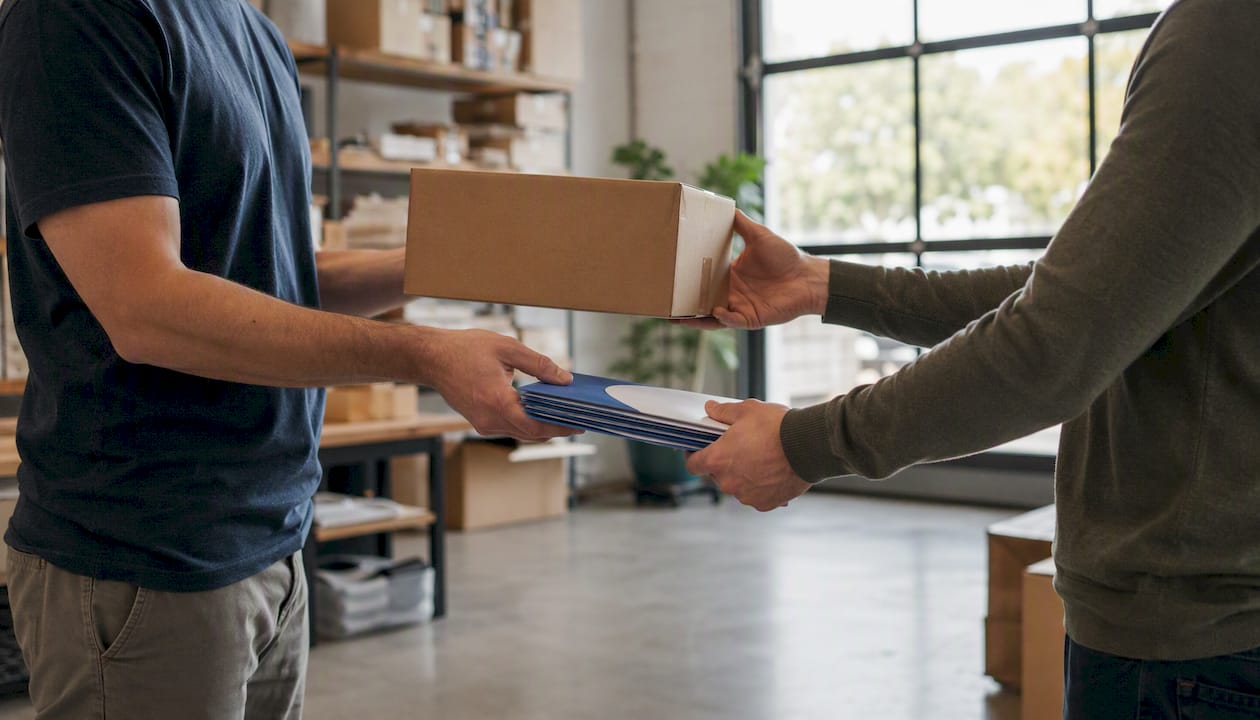
Co-hosting a local event (a free workshop, a neighborhood open house, or a community sponsorship) builds both visibility and trust simultaneously. The SBA specifically highlights local networking groups as one of the most effective early-customer channels, and that holds true for businesses at every stage.
Partnership outreach template (short email): “Hi [Name], I run [Business Name] in [City] and I think our customers overlap. Would you be open to a quick call about cross-referring clients? No cost, just a mutual benefit.”
For a practical example of how local service partnerships work in the field, the supply partner model at Local Skip Bin Hire illustrates how local service businesses can formalize referral and supply relationships to grow their customer base.
Lead capture: forms, SMS, and booking widgets
Driving traffic without a fast capture mechanism wastes every dollar you spend on ads. A phone number alone is not enough. Add a booking widget, a short contact form (name, phone, service needed), and an SMS opt-in on your highest-traffic pages.
Lead capture checklist:
- Place a phone number and a “Book Now” or “Get a Quote” button above the fold on every page
- Use a booking tool (Calendly, Acuity, or a native CMS widget) to let prospects self-schedule
- Add an SMS shortcode or click-to-text link for mobile visitors
- Set up an auto-response email or text that confirms receipt within two minutes
- Route all leads to one shared inbox or CRM so nothing falls through
Offline-to-online integration
Flyers, direct mail, and local radio still work when they carry a digital bridge. A postcard with a QR code that links to a ZIP-specific landing page, or a radio spot that ends with a short URL, connects offline reach to online tracking.
Offline integration checklist:
- Add a unique phone tracking number to each offline channel (use CallRail or a similar service)
- Include a QR code on all print materials that links to a landing page with a lead form
- Use a vanity URL on radio or print (e.g., “[yourbusiness].com/offer”) that redirects to a tracked page
- Match the offline offer to the online landing page exactly so there is no disconnect
How to build a repeatable local lead-generation system in 30 days
A tight 30-day experiment pairing GBP optimization, a small geo search-ad test, and a targeted outbound list can quickly reveal the highest-ROI channel for your specific market. Here is the week-by-week plan.
Week 1: Foundation
- Claim and fully optimize your Google Business Profile (owner or marketing lead)
- Audit NAP consistency across the top five directories
- Set up call tracking on your website and GBP
- Build a ZIP-code prospect list for outbound outreach (see the workflow section below)
- Draft two geo-targeted search ad variants and set a $15/day test budget
Week 2: Launch
- Apply for Local Services Ads and submit verification documents
- Launch geo search ads and monitor click-to-call rate daily
- Send 20–30 personalized outreach emails or calls to the ZIP-code prospect list
- Ask your last 10 customers for a Google review using the template above
- Post one GBP update and one locally relevant social post
Week 3: Optimize
- Pause any ad keyword with zero clicks after seven days
- Respond to all new reviews within 24 hours
- Identify your top-performing ad and double its daily budget
- Follow up with any outreach contacts who opened but did not reply
- Check GBP insights: which queries drove the most calls?
Week 4: Measure and decide
- Log total leads per channel in a simple spreadsheet (channel, date, lead type, outcome)
- Calculate cost-per-lead for each paid channel
- Identify the one or two channels with the lowest CPL and highest conversion rate
- Double down on those; pause or reduce spend on underperformers
- Set a 90-day plan based on what the data shows
KPIs to track every week:
- Cost-per-lead (total spend ÷ leads generated per channel)
- Conversion rate (leads that became paying customers ÷ total leads)
- Response time (average minutes from lead to first reply)
- Leads per week per channel
- Review count and average star rating
Pro Tip: Log leads in a shared Google Sheet with five columns: date, channel, lead type, response time, and outcome. After 30 days, the pattern is obvious. Most small businesses discover that a majority of their leads often come from a single dominant channel.
What does local lead generation actually cost?
The honest answer: it ranges from free (GBP, referrals) to several hundred dollars per month for paid channels. The table below shows realistic time-to-first-lead and steady-state timelines for the most common channels, along with rough cost orientation for a small business.
| Channel | Time to first lead | Steady-state | Typical cost range |
|---|---|---|---|
| Google Business Profile | 1–7 days (after verification) | Ongoing, free | Free to claim |
| Local Services Ads | 3–10 days (after verification) | Ongoing, pay-per-lead | Varies by service/market |
| Geo-targeted search ads | Typically provide paid results within a few days | Ongoing, requires budget | Usually involve a monthly budget consistent with small-scale testing |
| Local SEO (content + citations) | 60 days | Long-term, compounding | $10–$20 daily budget |
| Referral/partnership program | 7–30 days | Durable, low-cost | Near zero direct cost |
| Direct mail / offline | 7 days | Campaign-based | $15–$25 daily budget |
Primary cost drivers to watch:
- Service category competition (HVAC and legal services cost more per lead than niche services)
- Geographic density (urban ZIP codes cost more per click than suburban or rural ones)
- Profile completeness (incomplete GBP or LSA profiles increase cost-per-lead)
- Response speed (slow follow-up wastes paid leads and lowers LSA ranking)
A practitioner comparison of seven local lead methods found that GBP delivered the best overall organic inquiries, Google Ads produced the quickest results, and local SEO built the strongest long-term lead flow. That pattern holds across most service categories.
Common mistakes that waste your local lead budget
Most local lead budget waste comes down to six recurring errors. Each one has a fast fix.
- Inconsistent NAP across directories. Google cross-references your name, address, and phone across the web. A mismatch tanks local rankings. Fix: Run a free NAP audit on BrightLocal or Moz Local and correct every discrepancy this week.
- Slow response to inbound leads. A lead that waits more than 30 minutes is often already talking to a competitor. Fix: Set up SMS or email auto-replies that confirm receipt within two minutes, then call within five.
- Ignoring negative reviews. An unanswered one-star review signals to every future prospect that you do not care. Fix: Set a Google Alert for your business name and respond to every review within 48 hours.
- Targeting too broad a radius. A 50-mile radius on a local ad wastes budget on people who will never drive to you. Fix: Tighten to your actual service area by ZIP code.
- No conversion tracking. Running ads without tracking which keywords produce calls is burning money. Fix: Add Google’s call-tracking tag or use a call-tracking service before spending another dollar.
- Sending all ad traffic to your homepage. Homepages are not landing pages. They distract. Fix: Build one dedicated page per service with a single call to action.
Pro Tip: The single most common waste pattern: a business spends $500/month on ads, gets 20 calls, and has no idea which keyword or channel produced them. Install call tracking before you launch anything paid. It costs less than one lost lead.
How to use a local business discovery platform to accelerate lead capture
Faster discovery plus accurate contact data equals faster, higher-quality leads. Here is how to put that into practice using a platform like Local AI Page.
Step-by-step workflow:
- Claim your listing. Search for your business on Local AI Page by ZIP code. If it appears, claim it. If not, create a new profile. Claiming takes under 10 minutes.
- Complete every profile field. Business name, address, phone, website, service categories, service area by ZIP, hours, and a short description. Incomplete profiles rank lower and convert worse.
- Add photos and FAQs. Upload at least five photos and answer the three questions your customers ask most often. These fields directly influence whether a prospect contacts you or moves on.
- Connect contact details to your follow-up system. Make sure the phone number on your profile routes to a live line or a tracked voicemail. Add a booking link if you use one.
- Monitor and update. Check your profile monthly for accuracy. Update hours, add new services, and respond to any reviews that appear.
Profile optimization checklist:
- Service area listed by specific ZIP codes (not just city name)
- At least five photos including one of your team or work in progress
- Three or more FAQs answered in plain language
- Direct phone number that routes to a live person or tracked voicemail
- Booking or contact link active and tested
- Business description includes your city, top services, and a differentiator
Illustrative example (hypothetical): A home services business in a suburban market claimed its Local AI Page profile and filled every field, including ZIP-specific service areas and three FAQs. Within two weeks, inbound contacts from the platform increased because searchers could find the business by their exact ZIP code and see the answers to their questions before calling. The time from first discovery to first contact dropped because the profile removed the friction of having to search for a phone number or service area separately. (This is an illustrative scenario, not a documented case study.)
ZIP-code-level discovery pages, like local businesses in Barrington, IL, show exactly how a complete profile appears to a nearby searcher, including service areas, contact details, and FAQs, all in one place.
How does voice search affect local lead generation?
Voice search has shifted how people phrase local queries. Instead of typing “plumber Chicago,” someone speaking to a phone or smart speaker says “Who is the best plumber near me?” or “Find an HVAC repair company open now.” Those longer, conversational queries favor businesses with complete, accurate profiles and FAQ-style content on their websites.
Three practical adjustments make a real difference:
Write content that answers questions, not just keywords. A page titled “What does HVAC repair cost in [City]?” will capture more voice traffic than a page titled “[City] HVAC Repair Services.” Voice queries are questions; your content should be answers.
Keep your GBP hours current. “Open now” is one of the most common voice search filters. A business with outdated hours gets filtered out of those results entirely, regardless of how strong the rest of the profile is.
Use natural, spoken language in your descriptions. Schema markup with LocalBusiness type helps search engines parse your location and services for voice results. Short, direct answers in your FAQ section (under 30 words per answer) are more likely to be read aloud by a voice assistant than a paragraph of marketing copy.
Legal and privacy considerations for local lead generation
Collecting contact information from local prospects comes with legal obligations that vary by country and, in some cases, by state or province. The core principles apply broadly.
Consent before contact. In most jurisdictions, including those covered by GDPR (European Union), CASL (Canada), and CAN-SPAM (United States), you must have a legal basis for contacting someone. For email and SMS marketing, that typically means explicit opt-in consent. A contact form that says “Submit to get a quote” is generally sufficient for a follow-up call, but it does not automatically authorize ongoing marketing messages.
Data storage and security. Any lead data you collect (names, phone numbers, email addresses) must be stored securely. Do not keep lead lists in an unprotected spreadsheet shared across a team. Use a CRM with access controls, and delete data you no longer need.
SMS and text marketing rules. In the United States, the Telephone Consumer Protection Act (TCPA) requires written consent before sending marketing texts. A checkbox on your contact form that reads “I agree to receive text messages from [Business Name]” satisfies this requirement. Pre-checked boxes do not.
Review solicitation. Google’s terms prohibit incentivizing reviews (offering discounts, gifts, or cash in exchange for a review). Asking for a review is fine. Paying for one is not, and the consequences include profile suspension.
Local business directories and data accuracy. When you list your business on a directory or discovery platform, you are responsible for the accuracy of the information. Outdated addresses or phone numbers can create liability if a customer relies on them and cannot reach you.
This section covers general principles only. Consult a qualified legal professional for advice specific to your jurisdiction and business type.
The channel most small businesses get wrong
Most local service businesses spend their first marketing dollars on social media ads and ignore the two channels that actually produce the fastest, highest-intent leads: Local Services Ads and a fully optimized Google Business Profile. The reason is visibility. Social ads feel active because you can see impressions and likes. LSA and GBP feel passive because you set them up and wait. But the wait is shorter than most people expect, and the intent of the person who finds you through a local search is far higher than someone who saw a Facebook ad while scrolling.
The trade-off between speed and sustainability is real. Paid ads (LSA, geo search) produce leads quickly but stop the moment you pause spending. Local SEO and referral networks take longer to build but compound over time. For a small team with a limited budget, the right sequence is: get the free channels (GBP, referrals, directory listings) fully optimized first, then layer in paid channels once you have a baseline to measure against.
One thing that consistently gets underestimated: the profile quality on local business finder platforms matters as much as the channel itself. A business with a complete, photo-rich, FAQ-answered profile on Local AI Page will convert a higher percentage of profile views into contacts than a business with a bare-minimum listing, regardless of how much it spends on ads.
Local AI Page helps you get found by ZIP code
Every dollar you spend driving local traffic is wasted if the prospect cannot find your contact details, service area, or hours in one place. Local AI Page solves that specific problem: it lists local service businesses by ZIP code with verified profiles, direct contact details, service-area mapping, and owner-managed FAQs, all structured for AI-friendly discovery.
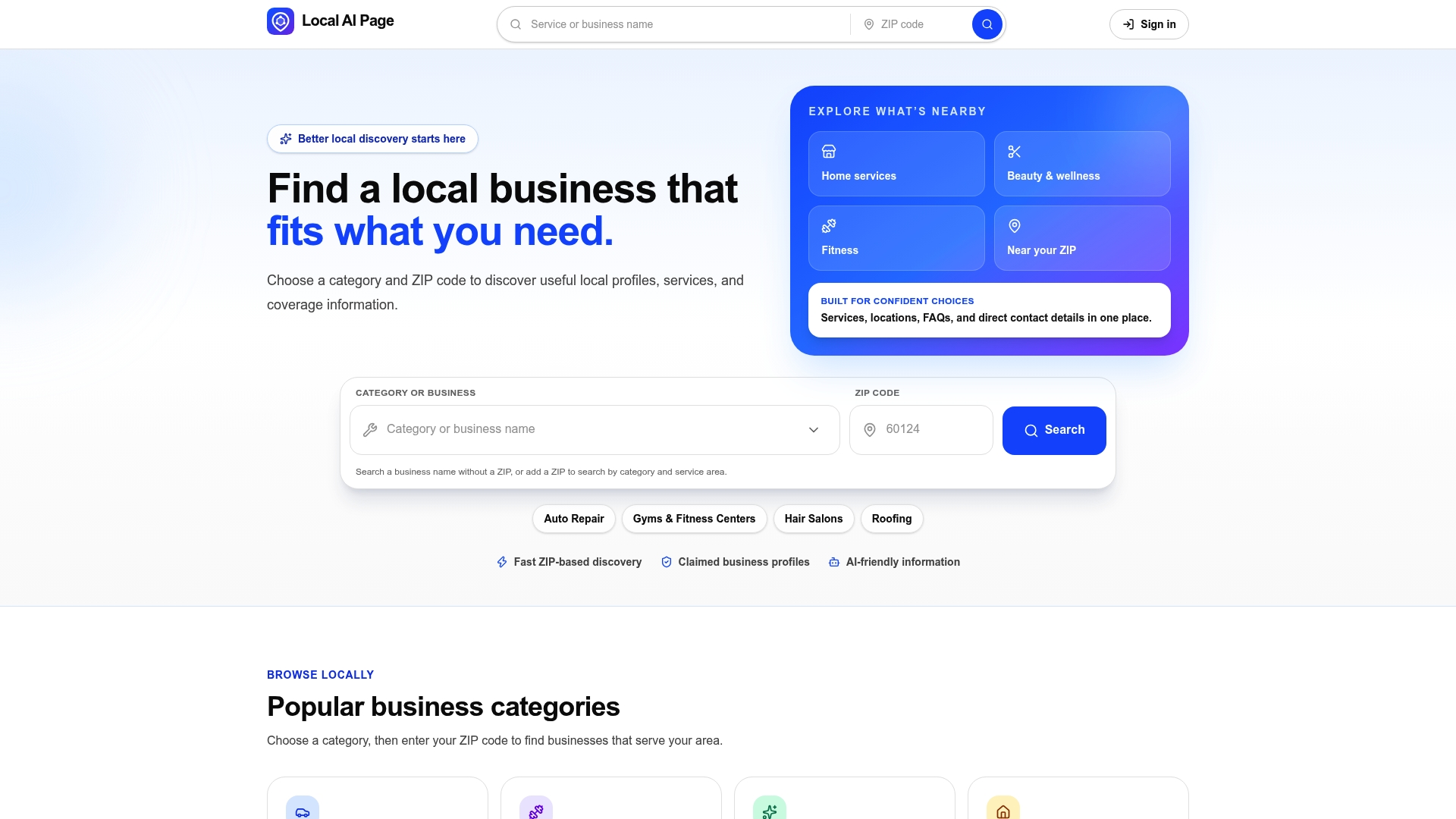
What that means in practice:
- Searchers find your business by entering their ZIP code, not just a city name
- Your profile shows service areas, hours, phone, and booking link on a single page
- Claimed listings let you update your own information in real time
- Complete profiles with photos and FAQs convert more profile views into direct contacts
- AI-friendly data structure means your business information surfaces accurately in AI-powered local searches
Claiming a listing takes under 10 minutes. Search your ZIP code on Local AI Page to see whether your business already appears, then claim and optimize your profile to start capturing leads from nearby searchers today.
Frequently asked questions
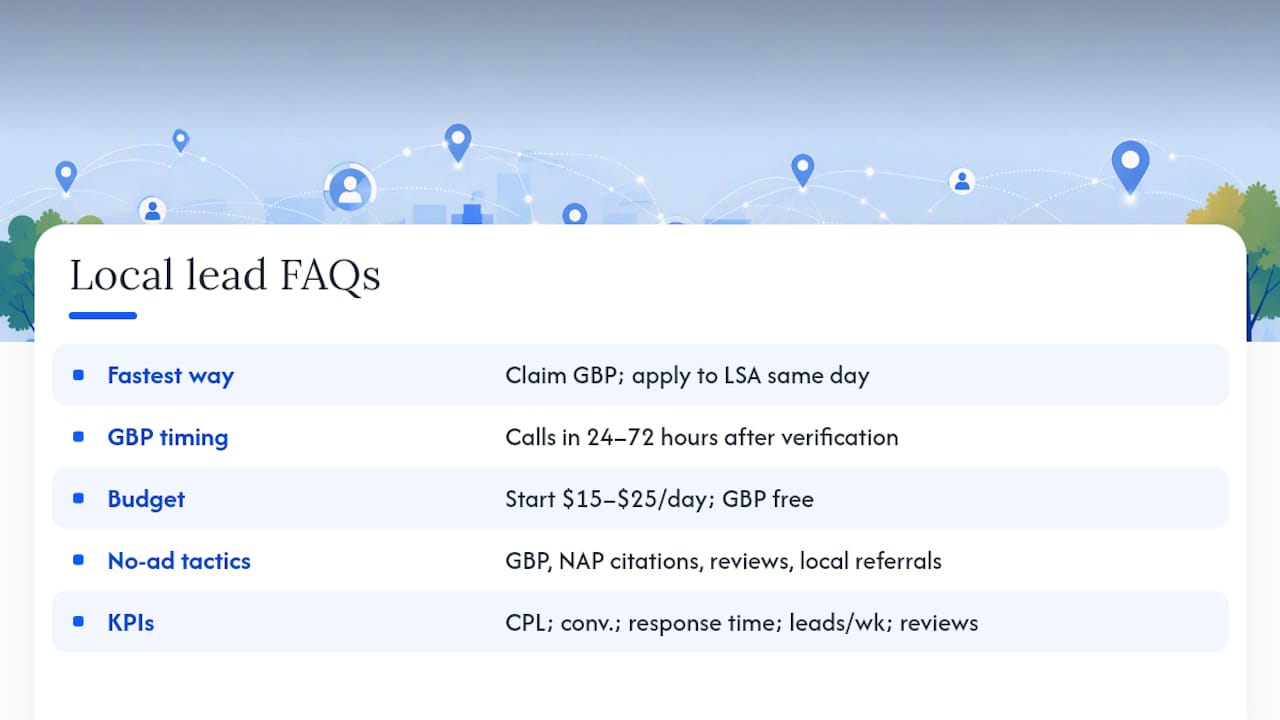
What is the fastest way to get local leads for a new business? Claim your Google Business Profile and apply for Local Services Ads on the same day. GBP can produce calls within 24–72 hours of verification. LSA takes a few days for background checks but delivers high-intent, pay-per-lead contacts once live.
How much should a small business spend to generate local leads? Start with $15–$25 per day on geo-targeted search ads and zero on GBP (it is free). After 30 days, calculate your cost-per-lead per channel and shift budget toward the lowest-cost source. Many small businesses find their GBP and referral network produce the majority of leads at near-zero cost.
How do I get local leads without paid advertising? Optimize your Google Business Profile, build consistent NAP citations across directories, ask every satisfied customer for a Google review, and actively pursue one or two local partnership referral arrangements. These three activities alone can generate steady inbound leads with no ad spend.
What KPIs should I track for local lead generation? Cost-per-lead, conversion rate (leads to paying customers), response time, leads per week per channel, and review count. Track these weekly in a simple spreadsheet for the first 30 days.
How does voice search affect local lead generation? Voice queries are conversational and question-based (“Who fixes AC near me?”). Businesses with complete GBP profiles, current hours, and FAQ-style website content are more likely to appear in voice results. Keep your hours updated and write short, direct answers to common customer questions.
Is it legal to collect lead information through a contact form? Generally yes, provided you have a clear privacy policy and the form explains how you will use the information. For SMS marketing, you need explicit written consent in most jurisdictions. Consult a legal professional for advice specific to your location.
Sources
- 8 ways to find your first customers | U.S. Small Business Administration (SBA)
- Local consumer review survey | BrightLocal
- Local lead generation strategies | ThomasNet Blog