
What Is the Typical Gym Membership Cost in 2026?
What Is the Typical Gym Membership Cost in 2026?

Most people pay between $50 and $69 a month for a standard gym membership in 2026, with the national benchmark hovering near $59. The full market stretches much wider than that, from bare-bones plans around $10 a month to premium clubs charging $300 or more.
Key Takeaways
| Point | Details |
|---|---|
| National benchmark | Expect $50 to $69 per month on average, with budget options near $10 and premium clubs above $300. |
| Hidden fees add up | Enrollment and annual maintenance fees can raise your first-year cost by 15% to 25% above the advertised rate. |
| Location drives price | Major cities often charge 60% to 100% more than the national average due to rent and demographics. |
| Contract length trade-off | Annual contracts save $5 to $15 a month but usually carry early cancellation fees if you break them. |
| Verify local pricing | Local AI Page lets you compare verified gym profiles, fees, and policies by ZIP code before you commit. |
Table of Contents
- Average Gym Membership Cost by Tier
- What Makes Gym Prices Vary So Much?
- How Do You Calculate the True First-Year Cost of a Gym Membership?
- What Should You Ask Before Signing a Gym Membership?
- How Can You Lower Your Effective Gym Membership Cost?
- Month-to-Month vs. Contract vs. Class-Pack: Which Costs Less?
- Does a Longer Commitment Actually Save You Money?
- What Local AI Page Sees When Comparing Gym Costs
- Compare Real Local Gym Pricing With Local AI Page
- Frequently Asked Questions
- Sources
Average Gym Membership Cost by Tier
Gyms cluster into four rough price bands, and knowing which one you’re shopping in saves you from comparing apples to kettlebells.
- Budget gyms: $10 to $25 a month. Basic equipment, minimal staff, no pool or classes. Think a warehouse of machines and a card-swipe entry.
- Mid-range gyms: $30 to $60 a month. Group fitness classes, more equipment variety, sometimes a pool or sauna.
- Boutique studios: $100 to $250 a month, often billed per class-pack instead of flat monthly rates. Cycling, HIIT, and specialty yoga studios live here.
- Premium/luxury clubs: $150 to $350+ a month. Full spa access, childcare, personal training built into the rate, multiple locations.
Advertised entry rates back this up. Budget chains have listed plans as low as $9.95, while luxury clubs regularly exceed $150 to $300+ once amenities and personal service are factored in. Location shifts these numbers too. A mid-range gym in a small town might sit at the bottom of its tier’s range, while the same tier in a dense metro area often lands near the top, simply because rent and staffing cost more there.
What Makes Gym Prices Vary So Much?
Four forces drive the gap between a $20 membership and a $200 one, and none of them are random.
- Rent and local labor costs. A gym in a high rent district has to charge more just to cover the lease, and that cost flows straight into your monthly bill.
- Amenities. Pools, saunas, childcare, and recovery rooms (cold plunge, infrared sauna, massage chairs) all add ongoing operating costs that get baked into membership pricing.
- Access level and digital features. 24/7 access, unlimited class credits, and app-based booking or tracking tools cost more to run than a gym with fixed hours and no app.
- Operator model. Franchise locations often set baseline pricing regionally, but local ownership, staffing choices, and even how aggressively a location discounts can shift the same brand’s price by $10 to $20 a month between two towns.
Location alone can be the single biggest multiplier. Major urban centers frequently charge 60% to 100% more than the national average, and dense city markets with younger, higher-income populations are exactly where boutique studios thrive on premium pricing. A modeled comparison across 301 U.S. cities shows averages ranging from about $46 a month in the cheapest markets to well over $100 in the priciest ones.
Pro Tip: Before comparing prices between two gyms, ask what’s actually included at that price point. A $40 membership with unlimited classes can beat a $30 membership that charges $15 per class on top.
How Do You Calculate the True First-Year Cost of a Gym Membership?
The number on the sign is rarely the number you’ll pay. Enrollment fees, annual maintenance charges, and add-on services routinely get billed separately from the advertised monthly rate, which is exactly why so many people underestimate what a “budget” membership actually costs them over twelve months.
Here’s how to run the math yourself:
- Start with the advertised monthly rate and multiply by 12.
- Add the one-time enrollment fee, typically $0 to $100.
- Add any annual maintenance fee, commonly $40 to $70.
- Add taxes if your local gym charges them separately.
- Add realistic upsell costs (a few personal training sessions, a locker rental).
- Divide the total by 12 to get your effective monthly cost.
A worked example: a $50/month gym with a $49 enrollment fee and a $59 annual maintenance charge comes to $600 (base) + $49 + $59 = $708 for the year, or about $59 effective monthly instead of $50. That’s a 18% jump over the sticker price, right in line with the typical 15% to 25% swing hidden fees create. Promotions change this equation fast: a waived enrollment fee saves you the $49 flat, while “two free months” effectively lowers your annual base to $500, a much bigger dent in the total.
What Should You Ask Before Signing a Gym Membership?
Match the gym to how you’ll actually use it before you match it to price. Someone who trains five days a week and someone who shows up twice a month should not be shopping for the same plan.
Run through this checklist first:
- How many days a week will you realistically go?
- How far is the commute, and does that distance survive a rainy Tuesday in February?
- Do you need childcare, a pool, or group classes, or just open floor space?
- Would a class-pack or pay-per-visit model beat a flat monthly fee at your usage level?
Then bring these eight questions to the membership desk:
- How long is the trial period, and what happens if I cancel during it?
- What’s the freeze policy, and does it pause annual fees too?
- What are the exact cancellation terms and any early termination fee?
- What’s the all-in total cost, including enrollment and annual fees, not just the monthly rate?
- Which classes are included versus billed separately?
- What’s the guest policy, and is there a fee per visit?
- What do personal training sessions cost per session, and is there a package rate?
- Does this membership work at other locations in the chain?
Watch for red flags: fee amounts that shift depending on who’s talking, high pressure to sign that day, and automatic renewal clauses that don’t require advance notice before rebilling you.
How Can You Lower Your Effective Gym Membership Cost?
Timing and paperwork save real money here, often more than negotiating ever will.
- Sign up in January or September. Gyms run their steepest promotions around New Year’s resolutions and back-to-school season, frequently waiving enrollment fees entirely.
- Check deal marketplaces before committing. A Groupon analysis of 1,799 gym deals found average discounts around 56% off rack rates, but always read what the deal actually covers before buying.
- Ask about employer, student, and military discounts. Many gyms offer 10% to 20% off for these groups, plus family plans that undercut two separate individual memberships.
- Consider a short-term pass instead of a contract if you’re testing a new gym or only training seasonally.
Pro Tip: Before buying a discounted class-pack deal, confirm it doesn’t lock you into personal training upsells or a limited class schedule once the promo period ends.
Month-to-Month vs. Contract vs. Class-Pack: Which Costs Less?
Flexibility and price pull in opposite directions almost every time. Month-to-month plans cost more per visit but let you cancel anytime, while annual contracts lock in a lower rate in exchange for an early termination fee if your life changes.
- Month-to-month: Higher rate, no long-term commitment, easiest to cancel or switch gyms.
- Annual contract: Lower monthly rate, savings of $5 to $15 a month typically, but breaking it early usually costs a fee.
- Prepaid packages: Pay upfront for 6 or 12 months at a discount; works if you’re confident you’ll stick with it.
- Class-credit and boutique subscriptions: You buy a set number of classes per month; unused credits often expire, which can quietly raise your real cost per visit.
Freeze policies matter more than people expect. A freeze that still charges the annual maintenance fee barely saves you anything, while one that fully suspends billing is worth asking about before you sign anything long-term.
Does a Longer Commitment Actually Save You Money?
Usually, yes, but not by as much as the sales pitch implies. Annual contracts typically shave $5 to $15 off the monthly rate compared to month-to-month billing at the same gym, which sounds appealing until you factor in what happens if you need to leave early.
Most gym contracts run 12 months, though some boutique studios and premium clubs push 24-month terms in exchange for steeper discounts. The math only favors you if you’re confident you’ll use the membership for the full term. Early cancellation fees can range from one to three months of remaining payments, which can erase the entire discount you signed up for if you break the contract in month four.
A useful way to judge this: normalize the price by expected use. Take your monthly fee and divide it by how many times you actually plan to go. A $70/month contract used eight times a month costs $8.75 per visit, while a $50/month plan used twice a month costs $25 per visit. The lower sticker price isn’t automatically the better deal once you run that number.
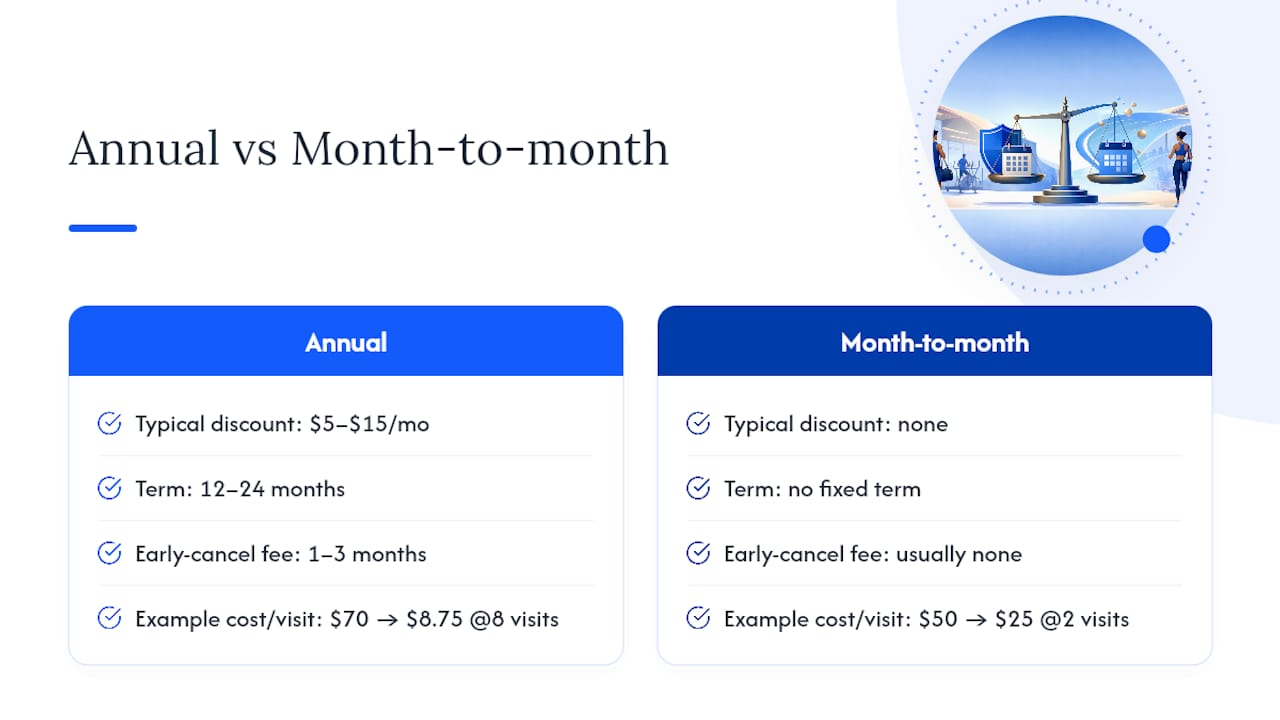
If your schedule is unpredictable, a shorter commitment or a month-to-month plan almost always beats a discounted annual contract, even at a higher headline rate. The savings on paper only materialize if you actually show up.
What Local AI Page Sees When Comparing Gym Costs
Every ZIP code tells a different pricing story, and the only way to know your local numbers is to check listings for your actual area rather than a national average. Local AI Page pulls together verified gym profiles with pricing details, FAQs, and direct contact information side by side, so you can catch an enrollment fee or a strict freeze policy before you’re standing at the front desk.

Comparing gyms by ZIP code surfaces the real local range instead of a nationwide guess, since the same brand can price wildly differently a few towns apart. Running a quick ZIP search before you commit takes the guesswork out of that first phone call.
Compare Real Local Gym Pricing With Local AI Page
Every number in this article is a national or city-level average. Your actual gym membership cost depends on the specific location down the street, and that’s where averages stop being useful.
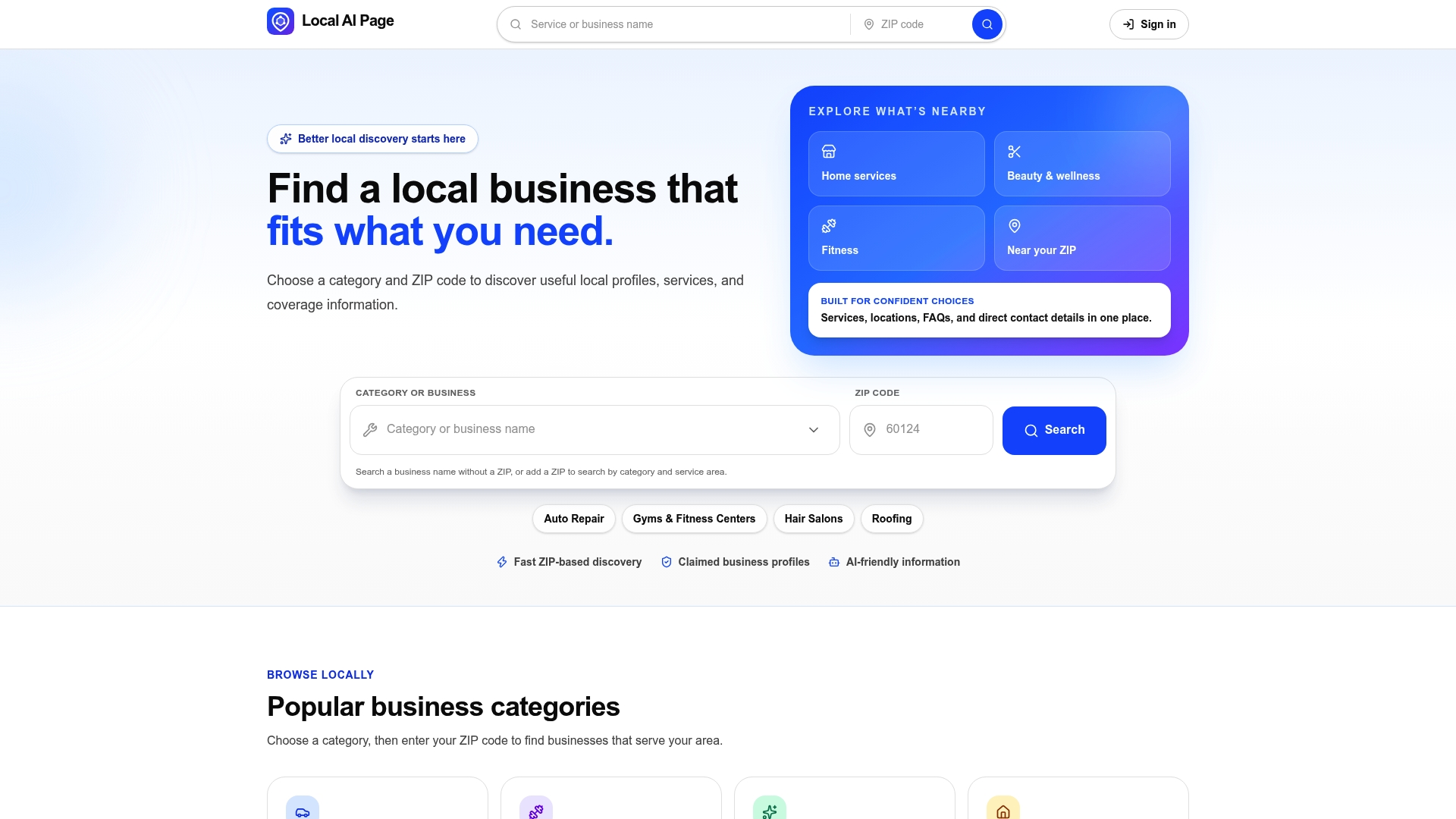
Local AI Page lets you search local businesses by ZIP code and pull up verified gym profiles with pricing details, service areas, FAQs, and direct contact information, all in one place. Instead of calling five gyms to compare enrollment fees and freeze policies, you can scan verified listings and see what’s actually offered before you walk in. A profile like ASAP Fitness in Wheeling shows the kind of detail you should expect: service area, contact info, and specifics that a generic search result won’t give you.
If you’re ready to see what gyms near you actually charge, browse local businesses by ZIP code and compare listings before you sign anything.
Frequently Asked Questions
What is the average gym membership cost in 2026? Most gyms charge between $50 and $69 a month nationally, with a common mid-point near $59. Budget gyms can run as low as $10, while premium clubs exceed $300.
Why do gym prices vary so much between cities? Rent, local labor costs, and demographics all factor in.
Are there hidden fees I should watch for? Yes.
Is a month-to-month membership better than a contract? It depends on your commitment level. Month-to-month plans cost more per visit but avoid cancellation fees. Annual contracts lower the monthly rate but usually lock you in with an early termination penalty.
How can I find the best gym deal near me? Check deal marketplaces for seasonal promotions, ask about employer or student discounts, and compare verified local listings by ZIP code to see actual pricing and fee structures before you sign up.
Sources
- How Much Does a Gym Membership Cost in 2026? Average Prices and Best Deals
- What Is the Average Cost of a Gym Membership?
- How Much Does a Gym Membership Cost? What to Consider