
Roofing Repair Cost in 2026: What Homeowners Should Expect
Roofing Repair Cost in 2026: What Homeowners Should Expect
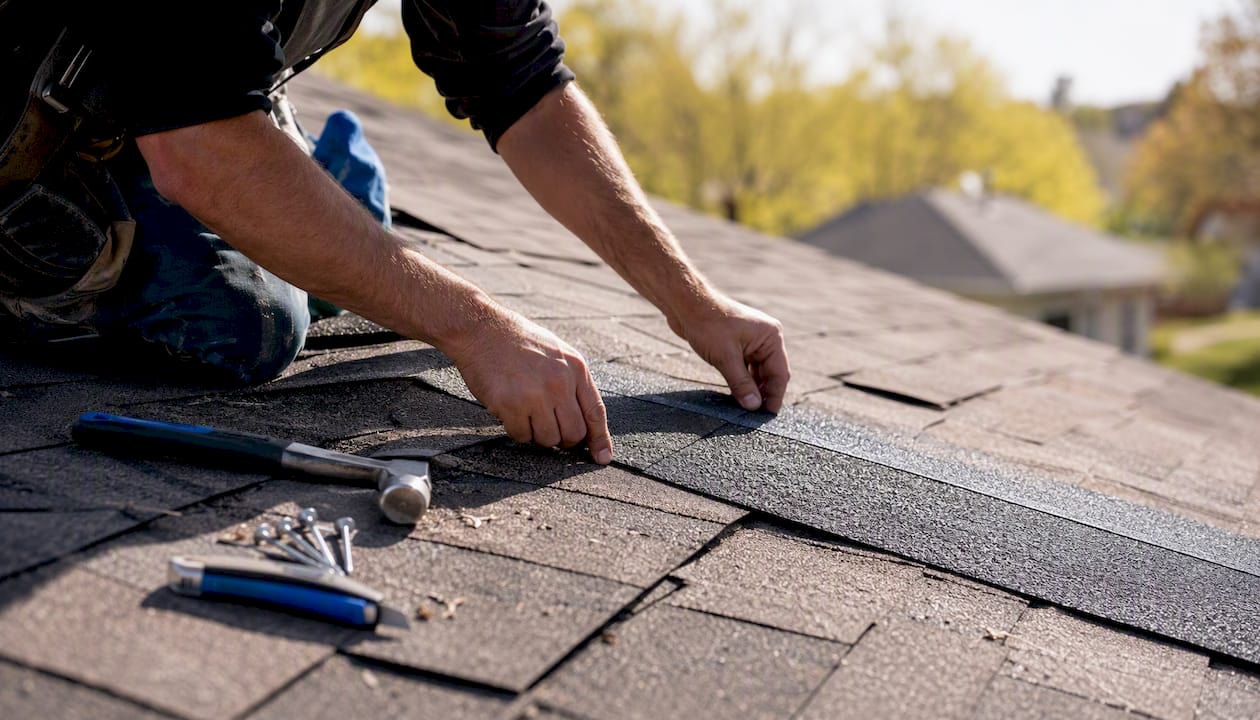
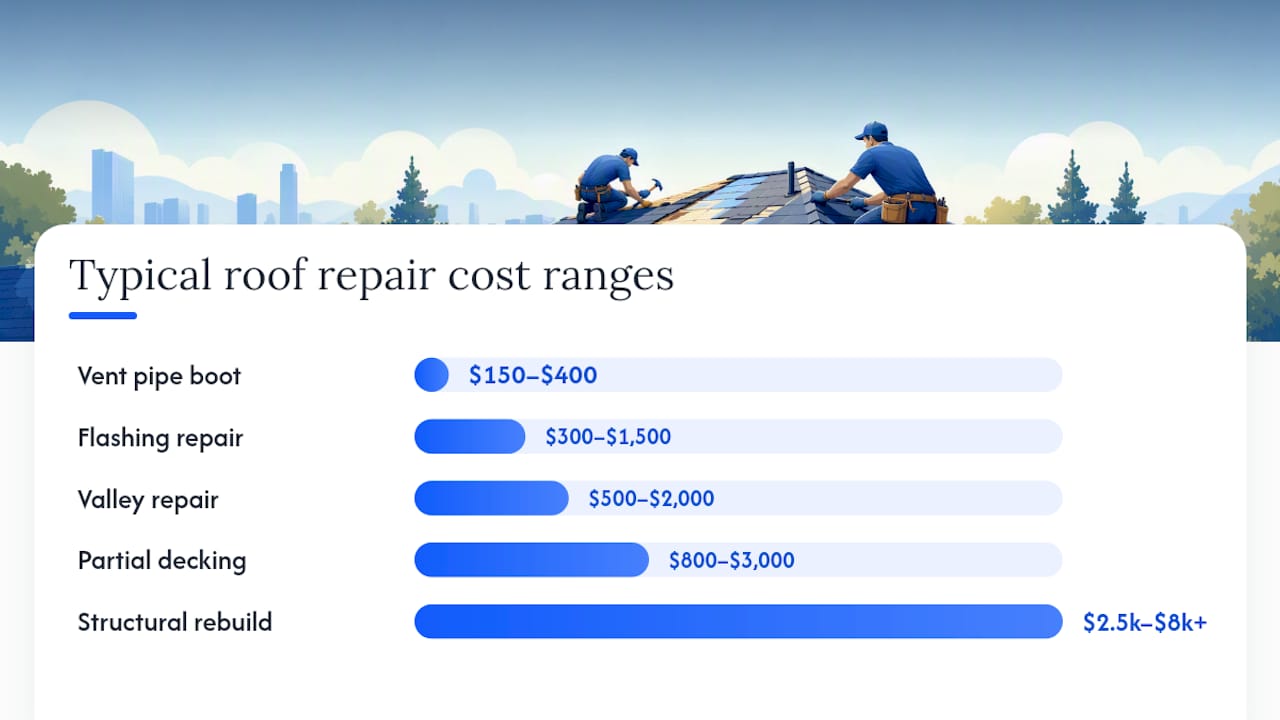
Most homeowners pay between $150 and $8,000 for roof repairs, with a national median around $1,150 according to Forbes Home. A simple shingle patch or pipe boot swap sits near the low end; structural decking work or a full valley rebuild pushes toward the top. Before any number means anything for your specific house, you need a ZIP-level quote, because labor rates, material costs, and local demand shift prices significantly from one market to the next.
- Low end ($150–$500): Minor shingle replacement, vent boot swap, small sealant patch
- Mid-range ($500–$2,500): Flashing repair, skylight resealing, partial decking, valley work
- High end ($2,500–$8,000+): Structural repairs, large decking replacement, multi-section rebuilds
Search your ZIP code on Local AI Page to pull up verified local roofers with contact details, service areas, and customer reviews so you can request quotes without cold-calling a dozen contractors.
Key Takeaways
| Point | Details |
|---|---|
| National cost range | Most repairs fall between $150 and $8,000; the typical homeowner median is around $1,150. |
| Repair vs. replace threshold | If your repair estimate exceeds 30–50% of replacement cost, get a full replacement bid before committing. |
| Delay multiplies cost | A deferred repair can cost 3–10x more once decking rot and interior damage enter the scope. |
| Get three written quotes | Compare line-item quotes, not just totals; include disposal, permits, and workmanship warranty terms. |
| Local AI Page | Search by ZIP on Local AI Page to find verified local roofers with service areas, reviews, and direct contact info. |
Table of Contents
- What drives roofing repair cost?
- What do typical repairs actually cost by repair type?
- How does roofing material affect repair cost?
- How will a contractor charge you, and what fees should you expect?
- Does homeowners insurance cover roof repairs, and how do warranties work?
- Should you repair or replace the roof?
- How do you get accurate local quotes and avoid cost surprises?
- How the estimates in this guide were derived
- The case for acting fast and budgeting realistically
- Find verified local roofers by ZIP code on Local AI Page
- Primary sources and further reading
- Sources
What drives roofing repair cost?
No two repair jobs price out the same way, and the gap between a $200 fix and a $5,000 fix usually comes down to a handful of compounding factors. Understanding them helps you read a contractor’s estimate critically instead of just accepting the bottom line.
Material type is one of the biggest levers. Asphalt shingles are the least expensive to source and replace. Metal panels, clay tile, and slate all require specialized labor and materials that cost two to four times more per repair than asphalt. Flat membrane systems (EPDM, TPO) fall somewhere in between but need contractors who know how to weld or bond seams correctly.
Repair type and scope matter just as much. Replacing three shingles takes an hour. Replacing rotted decking beneath those shingles, adding underlayment, and reinstalling the surface layer can take a full day or more. Flashing failures account for roughly 40–50% of residential leaks, and flashing repairs range from a quick reseal to a full tear-off and reinstall depending on how long the failure went unaddressed.
Roof geometry adds cost in predictable ways:
- Pitch/slope: Steeper roofs require safety equipment, slower work, and sometimes scaffolding. Expect a 10–20% labor premium on high-pitch roofs.
- Stories: A two-story home costs more to access than a single-story ranch. Three stories often requires a lift or crane.
- Footprint size: Larger roofs mean more material and more labor hours even for localized repairs.
Delay is expensive. A $400 flashing repair ignored for one season can become a $3,000 job once water penetrates the decking and soaks the insulation below. Prompt action keeps most jobs in the low-cost band; waiting multiplies costs when secondary interior damage enters the picture.
Site conditions and add-ons that show up in quotes:
- Scaffolding or lift rental: $200–$800 depending on height and duration
- Tear-off and disposal: $1–$2 per square foot of removed material
- Permit fees: $75–$350 depending on municipality
- Emergency tarping or temporary dry-in: $150–$500 (useful short-term, but adds to total cost if left for weeks)
- HVAC or attic protection during interior work
Timing and urgency carry real premiums. Emergency and after-hours repairs commonly add 25–50% to the base price. Scheduling repairs in late fall or winter in northern markets often means waiting for weather windows, which can extend timelines. Spring and summer are peak demand seasons, so contractors book out faster and sometimes charge more.
Pro Tip: Ask every contractor to break out labor, materials, disposal, and permit fees as separate line items. A lump-sum quote makes it nearly impossible to compare bids or spot inflated margins.
What do typical repairs actually cost by repair type?
Most roof leak repairs fall between $150 and $1,500, with the national average for a standard leak repair around $650. That range covers the vast majority of common homeowner scenarios. The table below maps repair type to realistic 2026 cost bands.
| Repair Type | Typical Cost Range | Typical Labor Time |
|---|---|---|
| Vent pipe boot replacement | $150–$400 | 1–2 hours |
| 1–5 shingles replaced | $150–$600 | 1–3 hours |
| Small patch / sealant repair | $150–$350 | 1–2 hours |
| Flashing repair or reseal | $300–$1,500 | 2–6 hours |
| Valley repair | $500–$2,000 | 4–8 hours |
| Skylight flashing / reseal | $400–$1,200 | 3–5 hours |
| Partial decking replacement | $800–$3,000 | 4 hours |
| Structural / full section rebuild | $2,500–$8,000+ | 1–3 days |
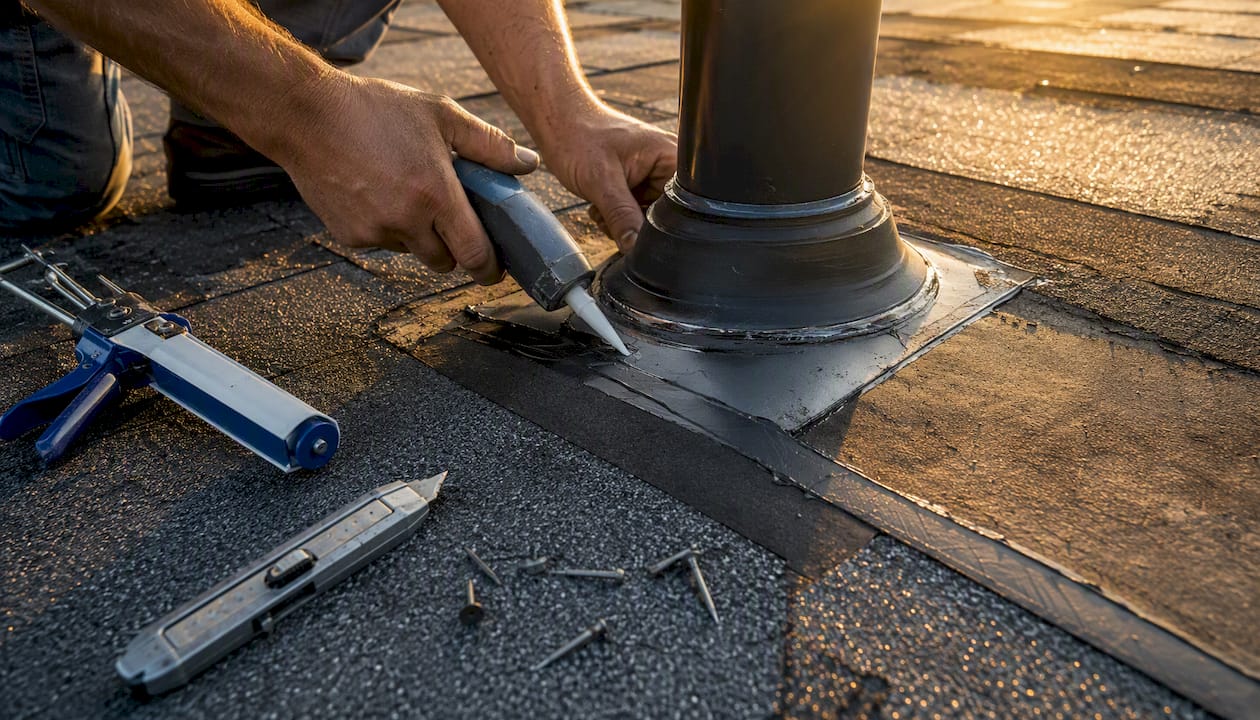
Minor repairs cover anything localized and surface-level. A vent pipe boot replacement, for example, runs $150–$400 and often takes under two hours. A retrofit collar like a Perma-Boot-style solution can be a durable, low-cost fix for this specific failure and is one of the few repairs where a confident DIYer can save real money.
Moderate repairs involve more labor and sometimes partial material removal. Flashing around a chimney or dormer is the most common example: a contractor needs to remove surrounding shingles, install new flashing, and reseal everything correctly. Skylight flashing failures follow the same pattern.
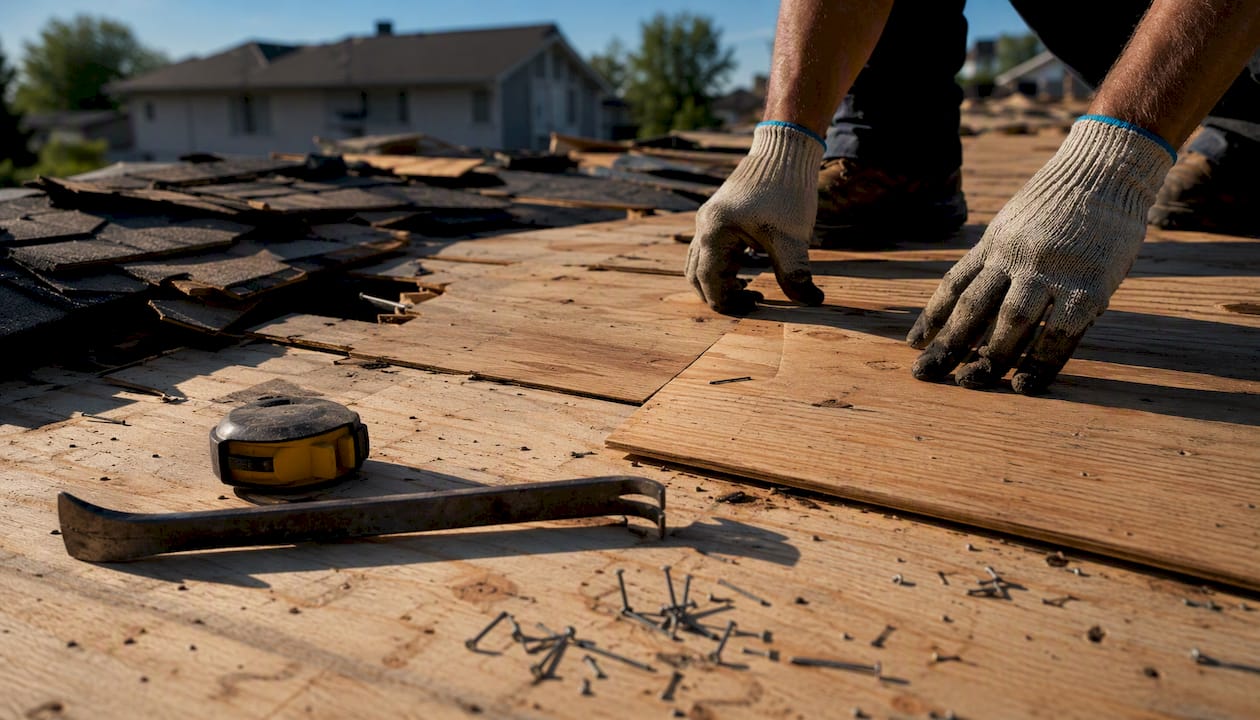
Major repairs start when decking rot is involved. Once water has been sitting long enough to soften the plywood or OSB beneath the surface layer, the repair scope jumps sharply. A detailed calculator modeled a typical mid-range project at around $6,486 total, roughly $54 per square foot, with the full modeled range running from about $1,323 up to $28,086 for complex scenarios.
You may be spending significant money to extend a roof that needs to come off within a few years anyway.
How does roofing material affect repair cost?
Material choice is the single biggest multiplier on per-unit repair cost. A contractor replacing asphalt shingles works faster, uses cheaper materials, and has more flexibility on scheduling than one working with slate or standing-seam metal.
- Asphalt 3-tab shingles: The least expensive to repair. Materials run $1–$2 per square foot; a typical shingle repair costs $150–$600 depending on how many courses are involved.
- Architectural (dimensional) asphalt: Slightly more expensive than 3-tab because matching the profile and color requires more care. Repairs typically run $200–$800.
- Metal (standing seam or corrugated): Requires specialized tools and skills to avoid panel damage. Expect $300–$1,500 for localized repairs; seam failures and panel replacements push higher.
- Wood shake: Labor-intensive to match and replace without disturbing adjacent shakes. Repairs run $400–$1,200 for small sections; fire-treated shake adds material cost.
- Concrete or clay tile: Tiles crack easily during repair if adjacent ones aren’t handled carefully. Matching discontinued tile colors is a recurring problem. Repairs typically cost $500–$2,000 for small sections.
- Slate: The most expensive material to repair. Genuine slate requires a specialist, and matching quarry and color can be difficult. Small repairs run $600–$3,000.
- Flat membranes (EPDM, TPO, modified bitumen): Repairs involve patching or heat-welding seams. Small patches run $300–$1,000; larger seam failures or ponding-water damage cost more.
| Material | Approx. Repair Cost per Sq Ft | Lifespan (Years) |
|---|---|---|
| Asphalt 3-tab | $1–$4 | 15–25 |
| Architectural asphalt | $2–$6 | 25–30 |
| Metal (standing seam) | $4–$10 | 40–50 |
| Wood shake | $5–$10 | 20–30 |
| Concrete / clay tile | $6–$15 | 40–50+ |
| Slate | $10–$30 | 75–150 |
| EPDM / TPO flat membrane | $3–$8 | 15–25 |
Lifespan matters for the repair-vs.-replace decision. A 20-year-old asphalt roof with a 25-year lifespan has maybe five years left. Spending $1,500 on repairs at that stage is a different calculation than spending the same amount on a 10-year-old architectural shingle roof with 20 years of life remaining.
How will a contractor charge you, and what fees should you expect?
Roofing contractors use several billing units, and quotes that mix them without explanation can be confusing. Knowing the conventions lets you sanity-check any estimate in about two minutes.
Common billing units:
- Per square (100 sq ft): The roofing industry’s standard unit. A 1,500 sq ft roof is 15 squares. Material and labor are often quoted per square for larger jobs.
- Per square foot: Used for smaller repairs and decking work. Easier for homeowners to cross-reference with calculator estimates.
- Per shingle or per bundle: A bundle covers roughly 33 sq ft; three bundles equal one square. Some contractors quote shingle replacement per bundle.
- Linear foot: Used for flashing, gutters, ridge cap, and drip edge. A 40-foot chimney perimeter might need 40 linear feet of new flashing.
- Hourly labor: Common for diagnostic inspections and small repairs where scope is unclear upfront. Rates vary by region but typically run $50–$100 per hour per worker.
- Minimum call-out fee: Many contractors charge a minimum of $150–$300 just to show up, regardless of how small the job is.
Quick math example: If a contractor quotes $8 per square foot for a 200 sq ft decking repair, that’s $1,600 in materials and labor before disposal and permit fees. At $80 per square (the per-100-sq-ft equivalent), the same job is 2 squares at $160 per square, which checks out.
Homewyse’s 2026 calculator puts basic repair baselines at $361–$439 per repair, which reflects a minimum-scope job. Real projects with disposal, permits, and multiple repair points will exceed that baseline.
Typical add-on line items to expect:
- Emergency tarping or temporary dry-in: $150–$500
- Debris disposal and haul-away: $75–$300 per load (or $1–$2 per sq ft of tear-off)
- Permit fees: $75–$350 depending on city or county
- Interior protection (plastic sheeting, drop cloths for attic work): $50–$150
- Travel or call-out minimum: $150–$300 if you’re outside a contractor’s primary service zone
For renovation debris and disposal cost planning, it helps to understand what contractors typically include in their haul-away fees versus what they pass through as a separate line item. Always ask upfront.
Does homeowners insurance cover roof repairs, and how do warranties work?
Insurance and warranties can dramatically reduce your out-of-pocket cost, but only if you understand what each one actually covers.
When insurance typically pays:
Homeowners insurance covers roof damage caused by sudden, covered perils: hail, wind, fire, falling trees, and similar events. What it does not cover is wear and tear, age-related deterioration, or damage from deferred maintenance. If your 25-year-old roof develops leaks because the shingles have simply aged out, your insurer will likely deny the claim.
Documentation your insurer will want:
- Dated photos of the damage (take them immediately after the event)
- A written contractor estimate with itemized scope
- Evidence of interior damage if water penetrated (ceiling stains, wet insulation, damaged drywall)
- A copy of the weather event report if the damage was storm-related
- Your policy’s declarations page showing your deductible and coverage limits
Deductible and claim strategy: If your deductible is $2,500 and the repair estimate is $1,800, filing a claim makes no financial sense. It also creates a claims record that can raise your premium. For smaller repairs, paying out of pocket is often the smarter move. Where insurance becomes critical is for major storm damage where repair or replacement costs run $5,000 or more.
Warranty types:
- Manufacturer’s material warranty: Covers defects in the roofing material itself. Asphalt shingle warranties typically run 25–50 years, though prorated coverage kicks in after the first decade. These warranties are usually non-transferable or transfer with a fee.
- Contractor workmanship warranty: Covers installation errors. Reputable contractors offer 2–10 years on labor. A contractor who won’t put a workmanship warranty in writing is a contractor worth walking away from.
A strong workmanship warranty matters most for flashing and valley work, where installation quality determines whether a repair lasts two years or twenty.
Should you repair or replace the roof?
This is the question most homeowners avoid asking directly because the answer might be expensive. But getting it wrong in either direction costs money.
Signs that replacement is the better call:
- The roof is past 80% of its expected lifespan (a 22-year-old 25-year asphalt roof, for example)
- You have leaks in more than two or three locations
- Shingles are curling, granule loss is heavy, or large sections are missing
- You’ve made the same repair more than once in the past three years
- Decking rot is widespread rather than isolated to one section
- The repair estimate exceeds 30–50% of what a full replacement would cost
Signs that repair makes sense:
- Damage is clearly localized to one area or one failure point
- The roof has significant remaining lifespan
- The repair estimate is well under 30% of replacement cost
- The cause of the damage is identifiable and fixable (a single failed flashing, one cracked tile)
Practical scenarios:
A 10-year-old architectural shingle roof with one failed vent boot and a small flashing gap? Repair it. A 23-year-old 3-tab asphalt roof with three separate leak points and granule-bare patches across two slopes? Get a replacement quote before committing to repairs. Spending $2,000 patching a roof that needs full replacement in 18 months is money that could have gone toward the new roof.
How do you get accurate local quotes and avoid cost surprises?
The difference between a good quote and a bad one usually comes down to preparation. Contractors who walk a job with a well-documented homeowner give sharper estimates.
Before you call anyone:
- Take photos of every visible damage point, including interior ceiling stains and attic wet spots.
- Note when you first noticed the problem and whether it followed a specific weather event.
- Measure your home’s rough footprint (length × width in feet) so you can cross-reference square footage claims.
- Check whether your municipality requires a permit for roof repairs above a certain scope.
Questions to ask every contractor:
- Will you provide a written, itemized scope of work before starting?
- What materials will you use, and can you show me the product spec sheet?
- What workmanship warranty do you offer, and is it in writing?
- Are you licensed and insured in this state? Can I see your certificate of insurance?
- Who pulls the permit, and is that cost included in your quote?
- How do you handle change orders if hidden damage is found once work starts?
- What is your payment schedule? (Never pay more than 10–30% upfront.)
Red flags to watch for:
- A contractor who shows up unsolicited after a storm and pressures you to sign the same day
- Requests for full payment in cash before work begins
- No written estimate or a vague one-line quote with no scope detail
- No proof of liability insurance or workers’ compensation coverage
- A price that is dramatically lower than every other bid (it usually means something is being skipped)
The Better Business Bureau maintains contractor complaint histories and accreditation records, which are worth checking before signing anything.
Typical timeline: A reputable contractor should be able to provide a written estimate within 2–5 business days of an inspection. Emergency repairs can be scheduled within 24–48 hours but carry the price premium discussed earlier. For non-emergency work, scheduling 2–4 weeks out is normal during peak season (April through September in most markets).
Pro Tip: Get at least three written quotes for any repair over $500. Compare them line by line, not just by total. A lower total with missing line items (no disposal, no permit) often ends up costing more.
How the estimates in this guide were derived
The cost ranges in this guide reflect a reconciliation of multiple 2026 industry sources, not a single calculator or survey.
Primary sources used:
- Forbes Home’s roof repair cost guide for national median and range ($150–$8,000; median $1,150)
- R&E Roofing’s 2026 price guide for leak-specific ranges and emergency premium data
- Homewyse’s 2026 repair calculator for baseline model inputs ($361–$439 per repair)
- HomeCostCalc’s 2026 calculator for per-square-foot modeling and complex project ranges
- The Roofing Brief’s 2026 synthesis for repair-type frequency data and DIY guidance
- BLS Occupational Employment and Wage Statistics for regional labor rate inputs used to adjust national medians
Where sources diverged (particularly for major structural repairs), the trimmed range excluded the top and bottom outliers and reported the central band. Per-square-foot figures were cross-checked against per-job totals using typical repair scope assumptions.
Disclaimers:
- Labor rates vary significantly by region. Markets like San Francisco, New York, and Boston typically run 30–50% above the national median; rural markets in the South and Midwest often run 15–25% below.
- Material costs fluctuate with supply chain conditions. Asphalt shingle prices in particular have moved with oil prices.
- Seasonal demand affects contractor availability and sometimes pricing. Spring and summer quotes in high-demand markets may run higher than off-season equivalents.
- Every figure in this guide is a planning benchmark. A written quote from a licensed local contractor is the only number you should actually budget against.
The case for acting fast and budgeting realistically
Most homeowners underestimate two things: how quickly a small leak compounds, and how much local variation actually matters when budgeting.
A $400 flashing repair that gets deferred through one winter can easily become a $2,500 job once the decking absorbs water and the insulation below needs replacing. The math on delay is brutal, and it’s one of the clearest cases where spending money now saves more money later. If you’ve noticed a stain on your ceiling or a soft spot on your roof deck, the time to call is this week, not next season.
Hidden damage is common once a contractor opens up a repair area, and change orders on roofing jobs are routine, not exceptional. A $1,200 quote that uncovers rotted decking can become $1,800 before the job is done. That’s not a contractor being dishonest; it’s the nature of working on a structure where you can’t see everything until you start pulling material.
Get two or three quotes, compare them line by line, and schedule outside peak season if your situation allows. A repair that isn’t urgent can often be booked in late fall or early winter at better availability and sometimes better pricing.
Find verified local roofers by ZIP code on Local AI Page
Knowing the national ranges is useful. Getting an actual quote from a contractor who serves your specific neighborhood is what turns a budget estimate into a real plan.

Local AI Page lets you search by ZIP code to find verified roofing contractors in your area, with profiles that include service areas, contact details, customer reviews, and FAQs. Instead of cold-calling five contractors and hoping they serve your address, you can see at a glance which local pros cover your ZIP, what services they offer, and how to reach them directly. For example, a verified roofing profile like G2 Exteriors in Lombard, IL shows exactly the kind of detail, service scope, and contact information you need before making a call. Enter your ZIP at Local AI Page to pull up local roofing contractors, compare their profiles, and request quotes without the guesswork.
Primary sources and further reading
The figures and ranges in this guide draw from the following sources. Each is worth bookmarking if you want to run your own scenario calculations or verify specific estimates before meeting with a contractor.
- Forbes Home: Roof Repair Cost Guide — National median ($1,150) and full range ($150–$8,000); broad repair-type breakdowns.
- R&E Roofing: 2026 Roof Leak Repair Cost Guide — Leak-specific pricing, emergency premium data, and pipe boot cost examples.
- Homewyse: Cost to Repair Roof (2026 Calculator) — Customizable baseline calculator; useful for adjusting by ZIP and local conditions.
- HomeCostCalc: Roof Leak Repair Cost Calculator (2026) — Per-square-foot modeling and complex project scenario ranges.
- The Roofing Brief: Roof Leak Repair in 2026 — Repair-type frequency data, flashing failure statistics, and DIY guidance.
- BLS Occupational Employment and Wage Statistics — Regional labor rate data used to adjust national medians for local markets.
ZIP-level quotes from licensed local contractors remain the only reliable way to convert these national benchmarks into a number you can actually budget against. Use these sources to set expectations and ask better questions, not to replace a written estimate.
Sources
- How Much Does Roof Repair Cost? – Forbes Home
- Roof Leak Repair Cost (2026 Price Guide) | What You’ll Pay | R&E Roofing
- Cost to Repair Roof - 2026 Cost Calculator (Customizable)
- Roof Leak Repair in 2026: Cost, DIY vs Pro | The Roofing Brief
- Bls